
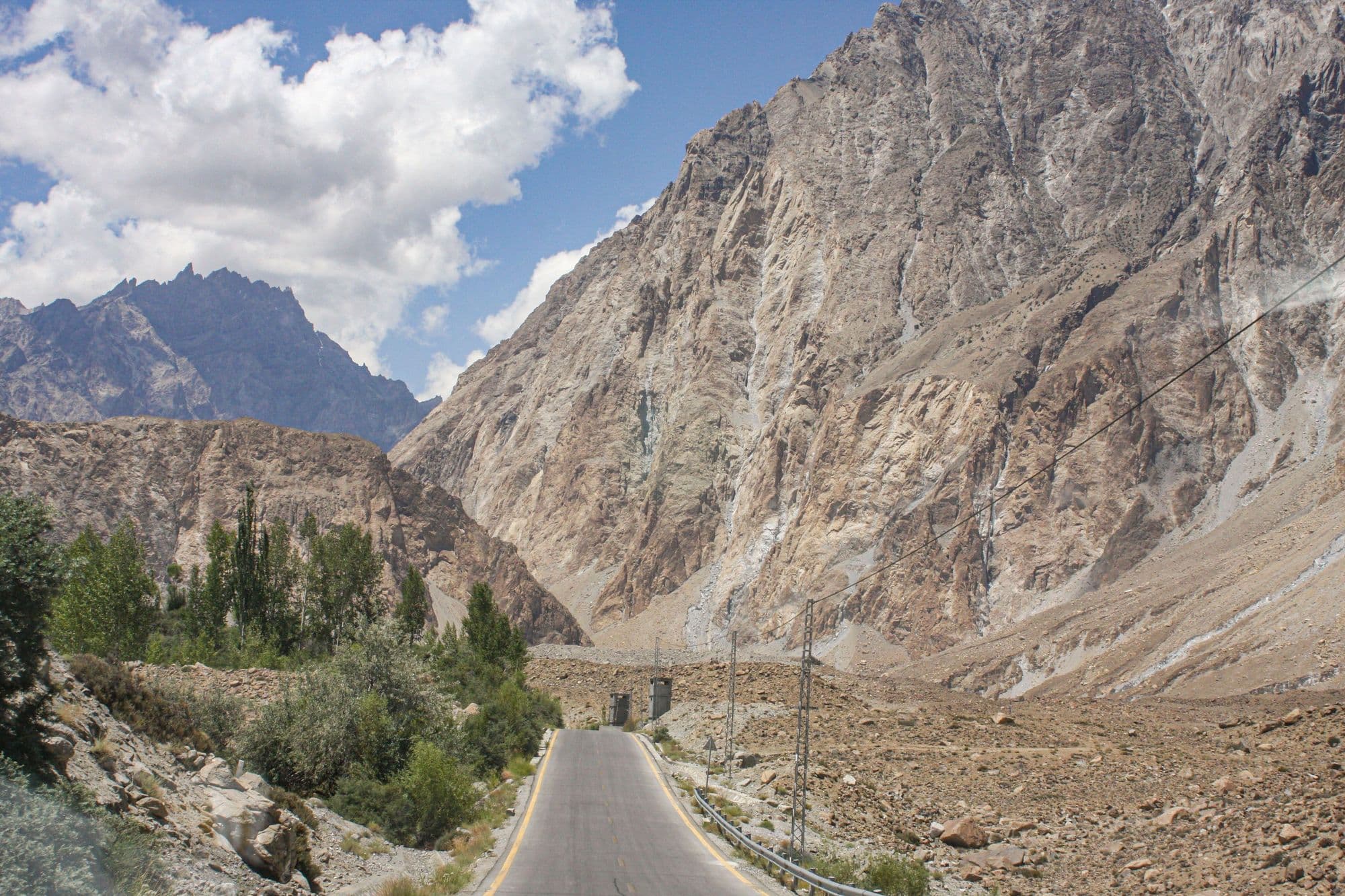
Give the Karakoram Highway seven days from Islamabad to Khunjerab Pass and back to Gilgit, and you will see the three great mountain ranges meet, Rakaposhi from the roadside, Attabad Lake, the Passu Cones and the highest paved border crossing in the world. Driving it in fewer days is possible, but you will spend the trip looking at the back of a truck instead of out of the window.
I have driven this road, as a passenger and as a guide, more times than I have driven anything else. Guests ask me for "the KKH itinerary" as if there were one. There are many, so here is the one I would do with a week and a car, plus the stops I think are worth stopping for.
The road in numbers
The KKH, National Highway N-35 in Pakistan, runs from Hasan Abdal near Islamabad up the Indus and Hunza rivers to the Chinese border at Khunjerab Pass, somewhere around 4,700 m depending on whose sign you read, then on to Kashgar. Islamabad to Hunza by road is 15 to 20 hours of driving depending on route, traffic and weather, and Gilgit to Hunza alone is about 100 km and two and a half to three hours (Go Pleiades, 2025). Karimabad to Khunjerab is about 150 km and three to four hours via Sost (Peaks of Pakistan).
The border is officially open to visitors from 1 May to 31 October and closed from November to April, with the exact dates set by snow rather than the calendar (Peaks of Pakistan; Against the Compass). Plan a Khunjerab day between June and early October and you will almost certainly get there.
Two ways out of Islamabad
Via Naran and Babusar Top (summer). Up the Kaghan Valley through Balakot and Naran, over Babusar at 4,173 m, and down to Chilas on the KKH. It is the scenic way and the one I prefer in July, August and September. Babusar normally opens in late May or June and shuts with the first heavy snow, usually around mid-October (Dawn, May 2025; Go Pleiades). From the pass to the Jaglot junction is another three to four hours of switchbacks and gorge (Zameen blog).
Via Besham and the Indus (all year). Abbottabad, Mansehra, then north along the Indus through Besham, Dasu and Chilas. It is open in every month, but it is narrower, slower through the dam works between Dasu and Chilas, and landslides are a real risk in the monsoon and in winter (Go Pleiades). Either way, do not drive the KKH at night. The road is unlit, the drops are long, and the trucks do not slow down.
The seven-day itinerary
Day 1: Islamabad to Naran or Besham. Leave by 6 am to cross Mansehra before the traffic. Summer: breakfast at Balakot, lunch at Naran, sleep at Naran. Winter or monsoon: push up the Indus to Besham. Either is a full day.
Day 2: Over Babusar to Chilas and Raikot Bridge. Tea at Lulusar Lake, photos at the top, then the long descent to Chilas. The first real KKH stop is Raikot Bridge, where the jeeps leave for Fairy Meadows and Nanga Parbat stands at the end of the valley. Push on to the Nanga Parbat viewpoint on the highway, then to Jaglot, where a signboard marks the point the Karakoram, Hindu Kush and Himalaya meet above the Indus and Gilgit rivers (Zameen blog). Sleep in Gilgit, or carry on to Hunza if you still have daylight: Jaglot to Karimabad is about three and a half hours.
Day 3: Gilgit to Karimabad, slowly. Rakaposhi viewpoint at Ghulmet is the single best roadside stop on the highway: a 7,788 m peak rising straight out of the Hunza river valley, with tea stalls where you can sit and watch it for an hour. Then Karimabad. Walk up to Baltit Fort, then along the old lanes to Altit Fort and its gardens. Drive to Duikar, the Eagle's Nest, for sunset over the whole valley. Two nights here.
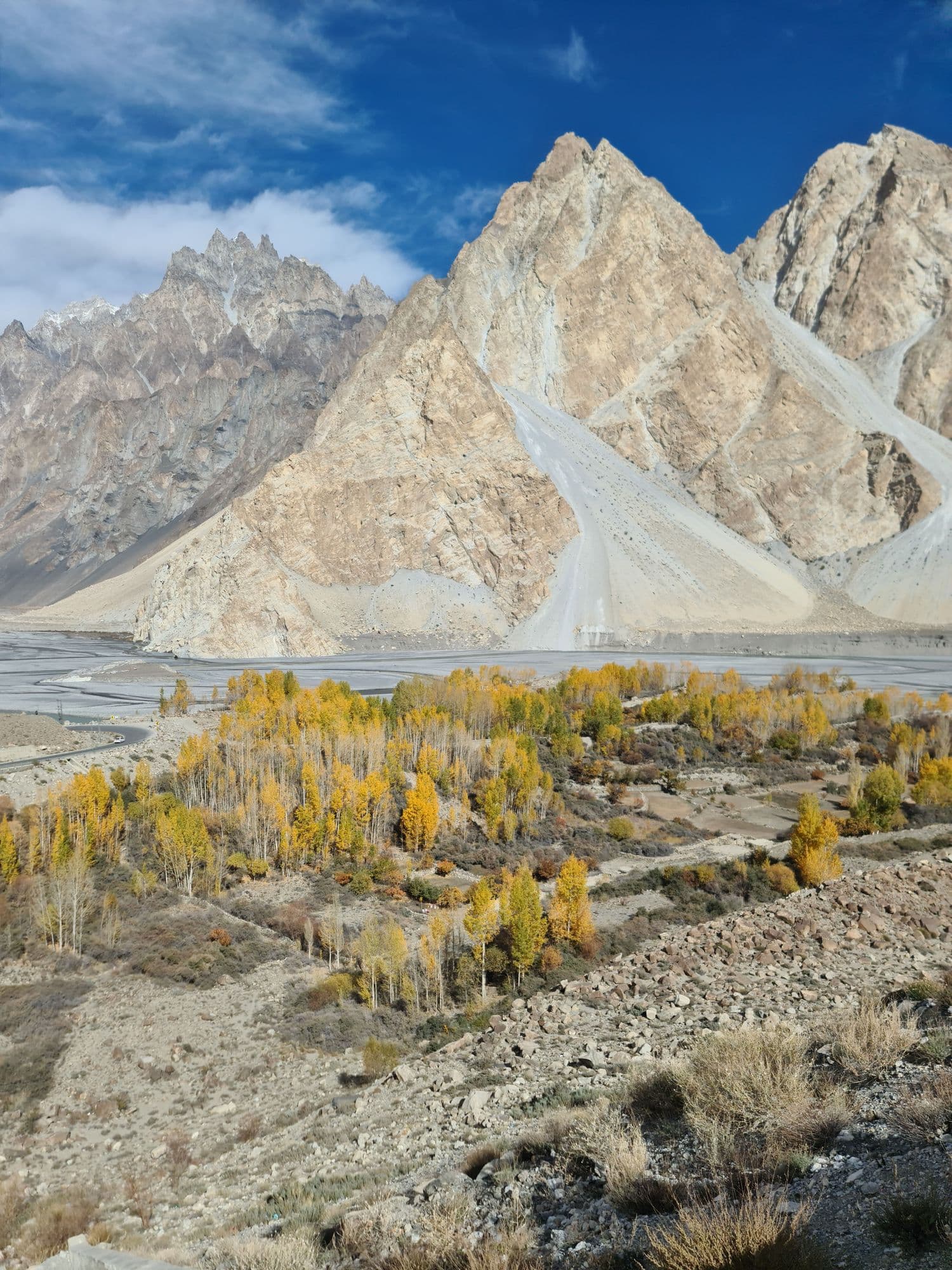
Day 4: Hunza rest day. Nagar side of the river to Hoper Glacier, or a slow morning in the Karimabad bazaar and an afternoon at Altit. If you are here in late October, this is the week the poplars and apricots go gold, and the day will plan itself.
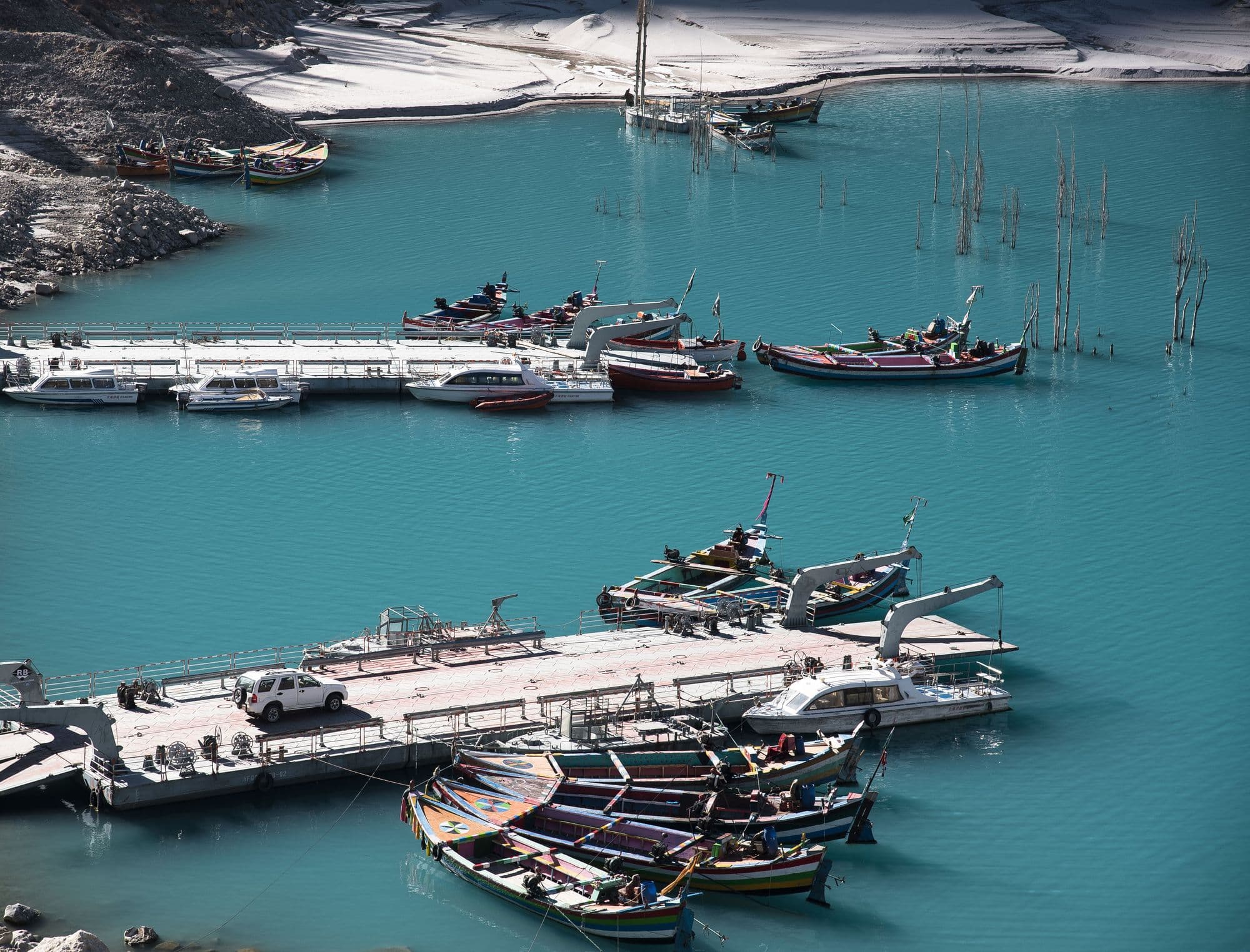
Day 5: Attabad, Gulmit, Hussaini and Passu. Through the Attabad tunnels to the lake, which was a village and a stretch of highway until the 2010 landslide dammed the river. Boats run from the jetty. Continue to Gulmit for lunch, then the Hussaini suspension bridge, which is as wobbly as the photographs suggest, and on to Passu, where the Cones line up above the highway and the glacier comes almost to the road. Sleep in Passu or Gulmit. This is my favourite night of the whole trip.
Day 6: Sost and Khunjerab Pass. Leave Passu by 7 am. Fill the tank at Sost, because there is no fuel between Sost and the pass (Peaks of Pakistan), buy the Khunjerab National Park ticket at the checkpost, and climb the last 90 km past yak pastures and, if you are lucky, ibex or a marmot colony on the roadside. At the top there is a border gate, a sign, a very high ATM and a lot of people breathing hard. Give yourself an hour, no more, and descend. Back in Karimabad by evening, or sleep in Gulmit.
The park entry fee for foreigners has been quoted anywhere from PKR 1,300 to a dollar-denominated fee in recent years, and it is collected at Sost. [confirm locally: the current Khunjerab National Park fee for foreign and Pakistani visitors with the Sost checkpost before quoting guests]
Day 7: Hunza to Gilgit, and fly or drive. Stop at Rakaposhi again if the morning is clear, then Gilgit for the afternoon flight to Islamabad, which takes about an hour when it runs (Go Pleiades). If it is cancelled, which happens, the Besham road gets you to Islamabad in a long day. This is why we always keep a vehicle on standby on our 13-day Ultimate Pakistan Tour, which runs this same highway before turning for Skardu and Lahore.
Stops I would not skip, and a few I would
Worth the stop: the three-ranges junction at Jaglot, Rakaposhi viewpoint, Baltit Fort, Duikar at sunset, Attabad from the water, the Hussaini bridge, the Passu Cones from the road just north of the village, and the pass itself. Skip, or keep short: the big new hotels around Attabad on a weekend, the Karimabad bazaar at midday in August, and any roadside stop at Chilas in the heat, which can be 40°C in July while Hunza is 25°C.
What the trip costs
Public transport is cheap. NATCO, Faisal Movers and the private operators run Rawalpindi to Gilgit and Hunza for about PKR 4,500 to 6,000 a seat, an 18 to 20 hour ride; tourist vans charge PKR 7,000 to 9,000 per person; a private car with driver, one way Islamabad to Hunza, is in the range of PKR 18,000 to 20,000 including fuel and tolls (Go Pleiades). For a comfortable 4x4 for the full seven days with a mountain driver, expect considerably more than a one-way transfer, as you are paying for the driver's time and the empty return. [confirm locally: Third Pole's current seven-day vehicle rate]
A mid-range guesthouse in Karimabad or Passu is in the low tens of thousands of rupees a night in season; meals are a few hundred to a couple of thousand rupees. Carry cash from Gilgit onwards. The Khunjerab ATM is a novelty, not a plan.
[owner: add a local detail here]
When to go
June and September are the kindest months: Babusar is open, the pass is open, the air is clear and the valley is not yet full. July and August are green and busy, with monsoon cloud on the southern half of the road. Late October is the autumn colour in Hunza, which is what our 13-day Gilgit-Baltistan Autumn Tour is built around, but by then Babusar may already be closed and you drive the Besham road. In winter the highway stays open, Hunza is quiet and bright, and Khunjerab is shut.
If you are coming for a trek rather than a road trip, the KKH is still your approach road: our 20-day Snow Lake / Biafo-Hispar La trek ends on the Hunza side at Hispar, so you can finish the glacier and roll straight into this itinerary from Day 3.
Plan your KKH trip with us
Download our free Pakistan Trip Planner 2027, with the KKH stops, driving times, Babusar and Khunjerab windows and a budget for every style of trip: get the free guide.
Or send us your dates and we will put a car, a driver who grew up on this road and the right guesthouses together for you: request a custom itinerary.
Halanch is a local guide with Third Pole Adventures, based in Hunza.
FAQ
Seven days from Islamabad to Khunjerab Pass and back to Gilgit is comfortable. Five is possible if you fly one way to Gilgit. Three is a blur of driving.
Yes, via Besham, though landslides can close it for hours. The Babusar Pass shortcut is open roughly June to mid-October, and Khunjerab Pass is open to visitors from May to October.
Around 15 to 20 hours of driving, normally split over two days with a night in Naran, Chilas or Besham. Gilgit to Hunza is about 100 km and under three hours.
Yes, as a day trip from Hunza or Sost with a passport and the national park ticket, bought at Sost. You cannot cross into China without a Chinese visa, and the crossing itself has its own hours.
The road is paved and busy, but it is narrow, high and unlit, and the trucks are relentless. Most visitors hire a car with a local driver and arrive relaxed. If you self-drive, never drive after dark and give yourself buffer days for landslides.
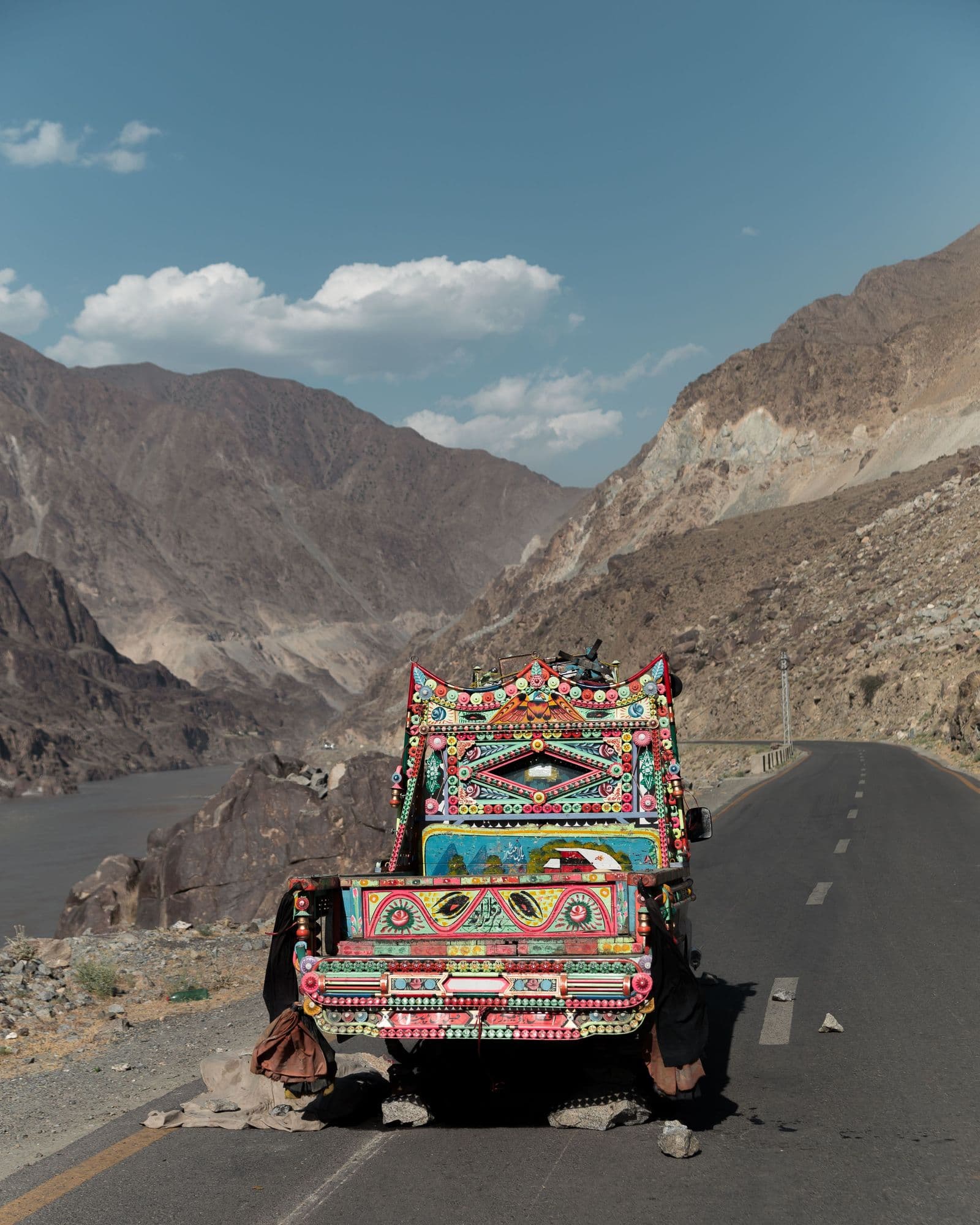
Hero, KKH in upper Hunza: Sohail Raza / Pexels (photo page, Pexels licence). Decorated truck: Taha Abbas / Pexels (photo page, Pexels licence). Attabad Lake jetty: Wasif Mehmood / Pexels (photo page, Pexels licence). Passu Cones in autumn: ERO SANZA / Pexels (photo page, Pexels licence).
Take the next step
Get the free Pakistan Trip Planner 2027, or tell us your dates and we will cost a private itinerary around them.
Comments (0)
No comments yet — be the first to share your thoughts.