

Why Trek to Snow Lake and Hispar La?
The Snow Lake Trek, also called the Biafo Hispar La Trek, is the most remote glacier crossing you can walk in Pakistan's Karakoram. It links Baltistan's Shigar district to Hunza and Nager. Over 10-plus days you join two of the longest glaciers outside the poles into one unbroken highway of ice, camping under a wall of unclimbed peaks and finishing in the Hispar valley of Nager, about two hours by jeep from Hunza. This isn't an out-and-back to see the glaciers and turn round; it's a true wilderness traverse from Baltistan into Gilgit, and it belongs on the short list of the world's great treks.
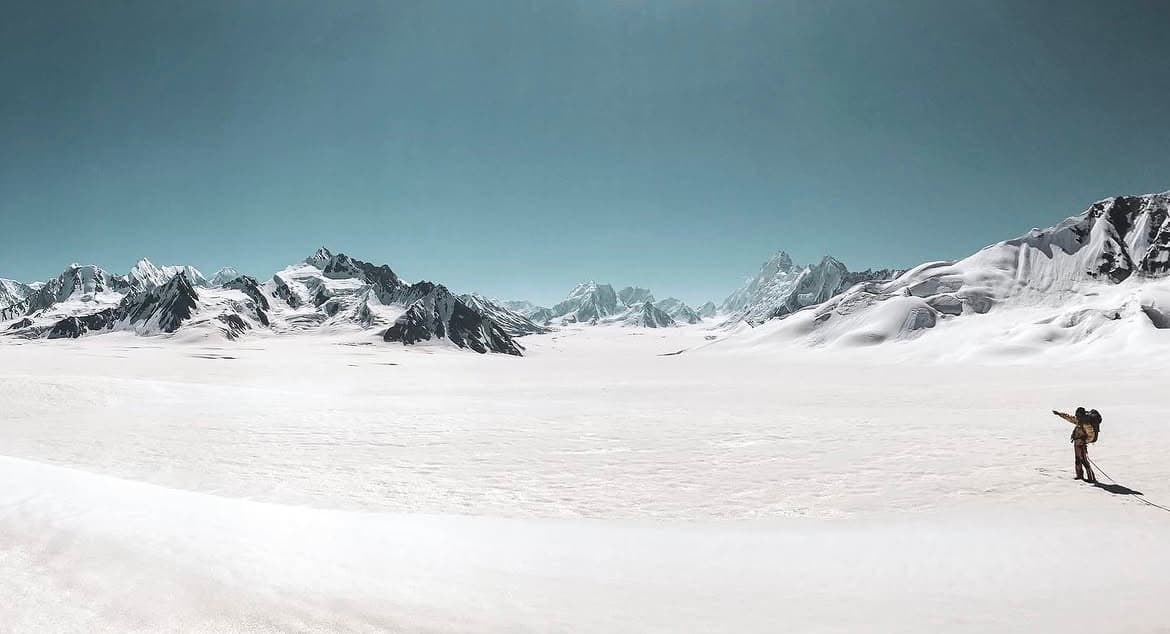
The Karakoram holds the densest concentration of glaciers anywhere outside the poles, and this trek runs through its frozen heart. Where the Biafo and Hispar meet lies Snow Lake, Lukpe Lawo, a glacial basin more than 16 km wide, ringed by peaks that were still being named within living memory. Sir Martin Conway reached it in 1892 and called it the finest mountain view he'd ever seen. More than a century on, that verdict still holds.
Trek Highlights
- Snow Lake (Lukpe Lawo): one of the largest interior glacial basins on Earth, a silent white amphitheatre of ice.
- Hispar La (5,150 m): a high pass where dawn light spills across the Biafo on one side and the Hunza peaks on the other.
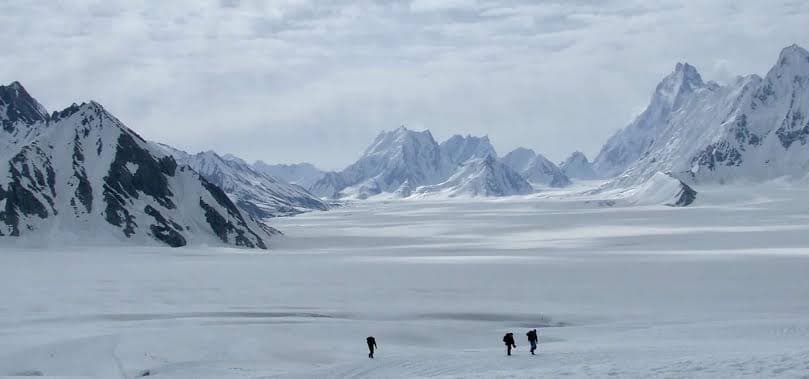
- The Biafo–Hispar ice highway: nearly 100 km of continuous glacier, the longest such system outside the poles.
- A real point-to-point traverse, from the Balti villages of Baltistan to the Burusho valleys of Hunza and Nagar.
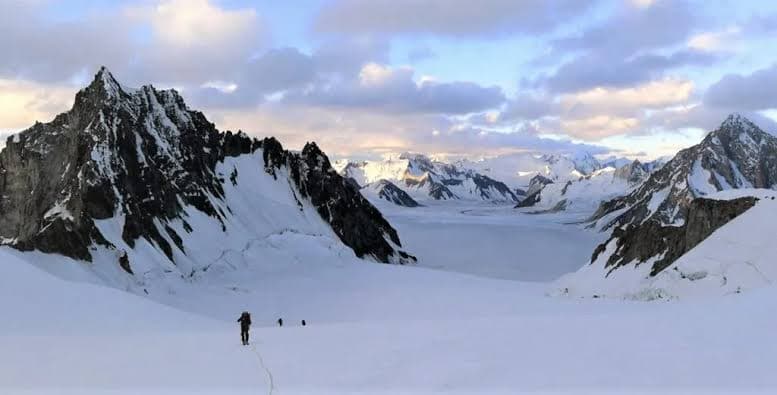
- A wall of giants: The Ogre (Baintha Brakk), the Latoks, Kanjut Sar, Kunyang Chhish, Disteghil Sar, Pumari Chhish and more.
- Rare wildlife: ibex on the grassy slopes and, if you're lucky, snow leopard, Himalayan brown bear and Marco Polo sheep.
- A finish in Hunza's orchards, famous for apricots, ancient forts and mountain hospitality.
Snow Lake Trek Itinerary — Day by Day (20 Days)
Camp names, altitudes and walking times are indicative. Karakoram weather and glacier conditions change fast, so your guide may adjust the schedule for safety and acclimatisation. Two contingency days are built in to protect your international flight home.
- DAY01
Arrival in Islamabad
~540 mYou're met at Islamabad airport and taken to your hotel. The evening is for a full trek briefing, gear check and paperwork over a welcome dinner. Rest up; an early start follows. Overnight: hotel, Islamabad.
- DAY02
Fly Islamabad to Skardu
~2,230 mWeather permitting, the stunning morning flight over the Karakoram to Skardu, with Nanga Parbat filling the window. If cloud grounds it, we drive the KKH instead, with an overnight en route. The rest of the day is free at altitude. Overnight: hotel, Skardu.
- DAY03
Acclimatisation and preparation in Skardu
~2,230 mA vital day to adjust to the thin air while the team finalises food, fuel, porters and permits. Options include a walk up to Kharpocho Fort, a trip to Satpara Lake, or last-minute shopping in the bazaar. Overnight: hotel, Skardu.
- DAY04
Jeep drive Skardu to Askole
~3,000 mA dramatic 4x4 up the Shigar and Braldu valleys, past barley fields and apricot orchards little changed in centuries. Askole is the last village on the route; beyond it, wilderness. We pitch our first camp here. Drive: 6–8 hrs. Overnight: camp, Askole.
- DAY05
Trek Askole to Namla
~3,570 mThe walk starts gently on the K2 Base Camp trail, then turns west onto the snout of the Biafo Glacier. We cross moraine and ice to Namla, a green camp behind a lateral moraine. Trek: 7–8 hrs, ~12 km. Overnight: camp, Namla.
- DAY06
Trek Namla to Mango
~3,715 mWe pick our way across a fractured stretch of glacier onto the central ice highway, following moraine ridges over loose rock. Camp is a grassy shelf on the flank of the Biafo. Trek: 5–6 hrs, ~7 km. Overnight: camp, Mango.
- DAY07
Trek Mango to Baintha
~4,041 mEasier going along the broad white spine of the Biafo. Baintha is one of the loveliest camps on the trek, a grassy oasis by the ice with the Latoks and the Ogre ahead. Trek: 6–7 hrs, ~11 km. Overnight: camp, Baintha.
- DAY08
Rest and acclimatisation at Baintha
~4,041 mA well-earned rest day for trekkers and porters. Wash up, do laundry, or hike the ridge behind camp for views of the Ogre (Baintha Brakk) and the Latok group. Watch for ibex on the higher slopes. Overnight: camp, Baintha.
- DAY09
Trek Baintha to Marphogoro
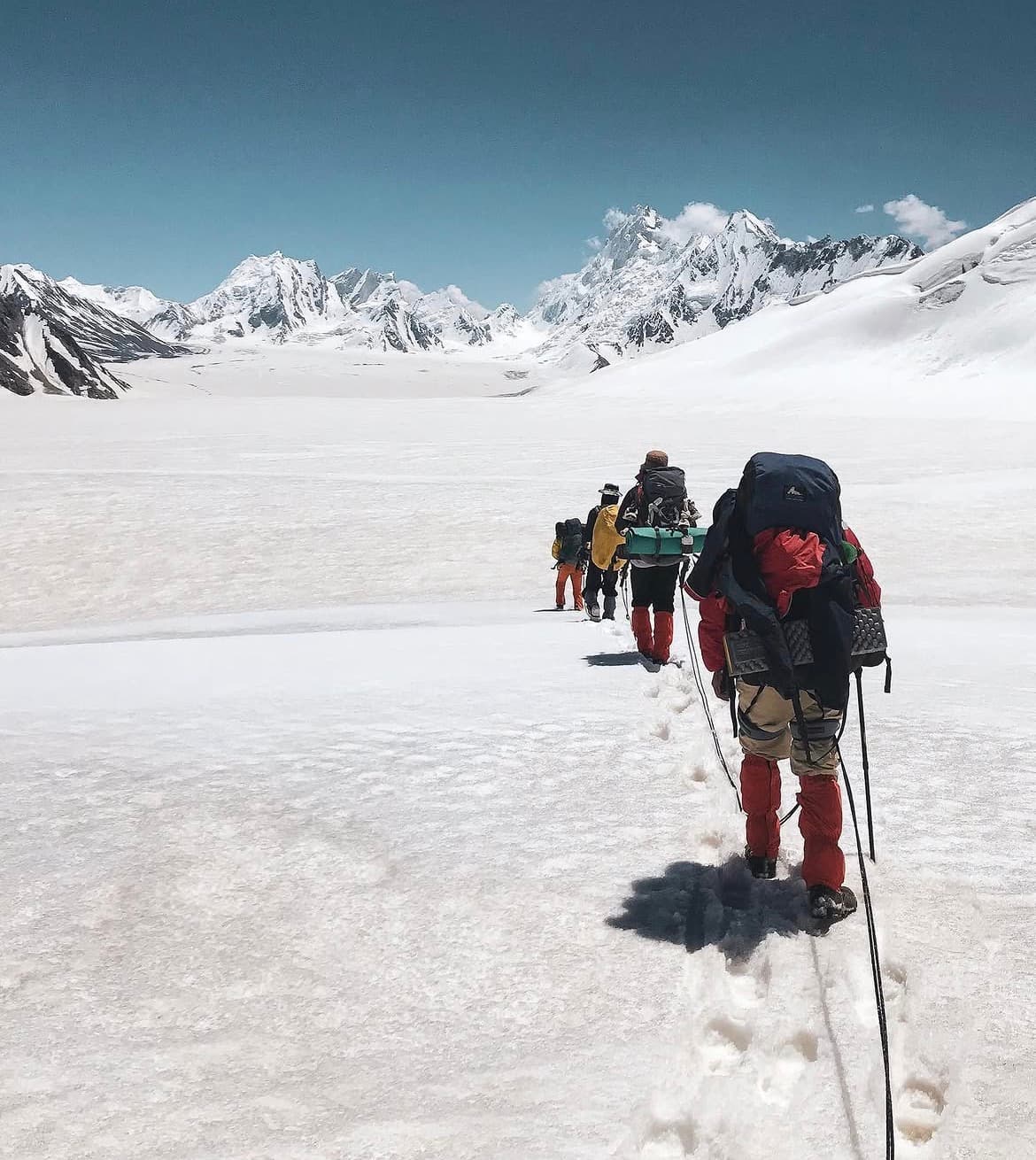
~4,298 mBack on the glacier, where the walking is straightforward but crevasses demand care, so we may rope up. Greenery falls behind and the world turns to rock, snow and ice, the Ogre towering to the right. First glimpses of Snow Lake and Hispar La. Trek: 5–6 hrs. Overnight: camp, Marphogoro.
- DAY10
Trek Marphogoro to Snow Lake / Hispar La Base Camp
~4,585 mWe thread a network of crevasses to the southern edge of Snow Lake, the vast basin at the head of the Biafo, and camp at the foot of Hispar La. Step out after dark; the star fields are unforgettable. Trek: 6–8 hrs. Overnight: camp, Hispar La Base Camp.
- DAY11
Cross Snow Lake and Hispar La; descend to Kani Basa
5,150 mThe big day. We rope up, cross Snow Lake and climb steadily to Hispar La at 5,150 m, not technical but hard work at altitude, for the finest panorama on the trek. An early start keeps the snow firm, then we descend the crevassed Hispar side to a green camp at Kani Basa (~4,468 m) under Kanjut Sar. Trek: 8–9 hrs. Overnight: camp, Kani Basa.
- DAY12
Trek Kani Basa to Jutmal
~4,168 mA rugged day through glacial moraine, loose scree and side-glacier crossings, with several streams to ford. Jutmal camp sits on grass beside the Hispar Glacier. Trek: 6–7 hrs. Overnight: camp, Jutmal.
- DAY13
Trek Jutmal to Bitanmal
~3,765 mWe cross another tributary glacier and drop into easier valley walking. Bitanmal is a broad summer meadow used by herders from Hispar village, a welcome patch of green. Trek: 7–8 hrs. Overnight: camp, Bitanmal.
- DAY14
Trek Bitanmal to Falaling Chhish
~3,605 mThe final glacier crossing, over the Kunyang Glacier, then a short climb to the shepherds' meadows of Falaling Chhish, with Makrong Chhish across the Hispar. Trek: 4–5 hrs. Overnight: camp, Falaling Chhish.
- DAY15
Trek to Hispar Village; drive to Hunza
~2,300 mA bridge over the Hispar torrent brings us to Hispar village, the first settlement since Askole and a riot of green after days of glacier. We meet the jeeps and drive down through Nagar to Hunza, and a hotel with hot showers. Trek: 3–4 hrs then drive. Overnight: hotel, Hunza.
- DAY16
Rest day in Hunza
A relaxed recovery day in Karimabad. Visit the 700-year-old Baltit and Altit forts, browse the bazaar for handicrafts, and take in Rakaposhi (7,788 m) and Lady Finger across the valley. Overnight: hotel, Hunza.
- DAY17
Drive Hunza to Gilgit
A scenic morning in Hunza, then the afternoon drive down the Karakoram Highway to Gilgit, ready for tomorrow's flight. Overnight: hotel, Gilgit.
- DAY18
Fly Gilgit to Islamabad
~540 mWe fly back to Islamabad, or drive the KKH over Babusar if weather grounds the flight. A final group dinner celebrates the crossing. Overnight: hotel, Islamabad.
- DAY19
Contingency day
A buffer day held against weather or travel delays earlier in the trip, a standard safeguard for any Karakoram itinerary. If unused, it's free time to sightsee, shop or rest. Overnight: hotel, Islamabad.
- DAY20
Departure from Islamabad
Transfer to Islamabad airport for your onward flight home, carrying the memory of one of the last great wilderness treks on Earth.
Dates for 2027
| Ex-Islamabad | From | To | Duration |
|---|---|---|---|
| 1st Departure | 26 Jun 2027 | 15 Jul 2027 | 20d / 19n |
| 2nd Departure | 03 Jul 2027 | 22 Jul 2027 | 20d / 19n |
| 3rd Departure | 10 Jul 2027 | 29 Jul 2027 | 20d / 19n |
| 4th Departure | 24 Jul 2027 | 12 Aug 2027 | 20d / 19n |
| 5th Departure | 07 Aug 2027 | 26 Aug 2027 | 20d / 19n |
| 6th Departure | 21 Aug 2027 | 09 Sep 2027 | 20d / 19n |
How Difficult Is the Snow Lake Trek?
Make no mistake, the Snow Lake trek is graded extremely strenuous and is widely considered harder than K2 Base Camp. It's not the climbing that's tough but the mix of remoteness, sustained glacier travel and altitude. About two-thirds of the route is on ice, and Hispar La means roping up through crevassed terrain. There are no teahouses, no roads and no phone signal for the best part of two weeks; everything is carried and camped.
Who This Trek Is For
- Fit trekkers with previous multi-day experience above 4,000 m.
- People comfortable with long days (up to 8–9 hours) on rough glacier and moraine.
- Anyone after real isolation rather than a busy, popular trail.
Build three to six months of cardio and hill training before you come. Strong legs, good balance and the stamina to walk long hours with a light daypack matter far more than raw speed.
Best Time to Do the Biafo Hispar Snow Lake Trek
The trekking window runs from late June to early September, the Karakoram's most stable spell. Unlike the Himalaya, this range sits mostly outside the monsoon, so summer skies are often bright and clear.
- June: firm snow and quiet trails, but cold nights and some snow underfoot on the higher glacier.
- July–August: the peak, warmest and most settled, with the best glacier visibility.
- Early September: clear skies and fine views, colder as the season closes.
Temperatures swing from pleasant walking by day to well below freezing at the high camps. Be ready for sudden weather; the mountains here set their own rules.
Essential Packing List
A full kit list comes in your pre-departure dossier. The essentials:
- Sturdy, broken-in trekking boots over the ankle, plus camp sandals for river crossings.
- A four-season sleeping bag (comfort-rated to about −15 °C) and an insulated mat.
- Layers: thermal base layers, fleece, an insulated down jacket, and waterproof shell and over-trousers.
- Warm hat, sun hat, glacier-grade sunglasses, insulated gloves and a headtorch with spares.
- Trekking poles, a personal first-aid kit (with altitude and rehydration essentials), sunscreen and lip block.
- Two one-litre water bottles or a thermos, plus water-purification tablets.
Group glacier gear such as ropes and an ice axe is provided by Third Pole Adventures. You won't need personal crampons on this route unless we advise otherwise.
What's Included and Excluded
Included
- All domestic flights and road transfers within Pakistan, including airport pick-up and drop-off.
- Twin-share hotels in Islamabad, Skardu, Hunza and Gilgit.
- All camping gear on trek: two-person tents, mess and kitchen tents, mattresses, tables and chairs.
- All meals on trek and full board where specified, plus tea, coffee and trail snacks.
- A licensed English-speaking mountain guide, cook and support crew.
- Porter service for your personal luggage (up to the stated limit) and all group loads.
- National park and trekking permits, camping and bridge fees, and a visa letter of invitation.
- Group safety gear, a basic first-aid kit and a satellite phone for emergencies.
Excluded
- International airfare and the Pakistan visa fee.
- Personal travel and rescue insurance (mandatory for this trek).
- Personal trekking gear and equipment.
- Some city meals, drinks, and personal items (laundry, calls, souvenirs).
- Tips for guides, cooks and porters, and any cost from delays beyond our control.
Our Social Responsibility: Three Trekkers, One Child in School
Every Snow Lake trek depends on the strength and good humour of the Balti and Hunza porters who carry our loads across the ice. We think adventure tourism should leave something lasting behind, so we've put education at the centre of our giving.
For every three foreign trekkers who join us, Third Pole Adventures funds a full year of schooling for one child in the remotest parts of Gilgit-Baltistan.
These are the villages at the very end of the road, where one sponsored school year can change a child's life. We give on the basis of need, with a particular focus on girls' education: educating girls in mountain communities lowers infant and maternal mortality, reduces early marriage, and lifts the whole valley over time.
So your journey across the ice leaves a trail of opportunity behind it. If you'd like to do more, you can sponsor additional students directly; just ask our team.
Ready to Walk the World's Greatest Glacier Highway?
Book your Snow Lake Trek with Third Pole Adventures. 2027 departures are open now, and private or custom dates can be arranged on request.
Frequently asked questions
Yes. Both are serious high-altitude treks, but Snow Lake is more remote, spends far longer on glaciers, and crosses Hispar La, so it's generally rated the tougher of the two.
No technical climbing is needed. You do walk roped together across crevassed glacier, and your guide briefs you on the basics beforehand. Previous high-altitude trekking experience is strongly recommended.
The high point is Hispar La at 5,150 m (16,896 ft). The itinerary builds in gradual ascent and a rest day at Baintha to help you acclimatise.
Mountain flights depend on clear weather and are sometimes grounded. When that happens we travel by road on the Karakoram Highway, and the two contingency days exist to protect your international flight home.
Gilgit-Baltistan has a long record of peaceful hospitality and is very welcoming to trekkers. We watch conditions closely, travel with licensed guides, and never trek solo, which is also a legal requirement in Pakistan.
Yes. We run scheduled group departures and can also tailor private trips for couples, friends and expedition groups. Send us your preferred dates.
Scenes from the trail
Related treks & tours
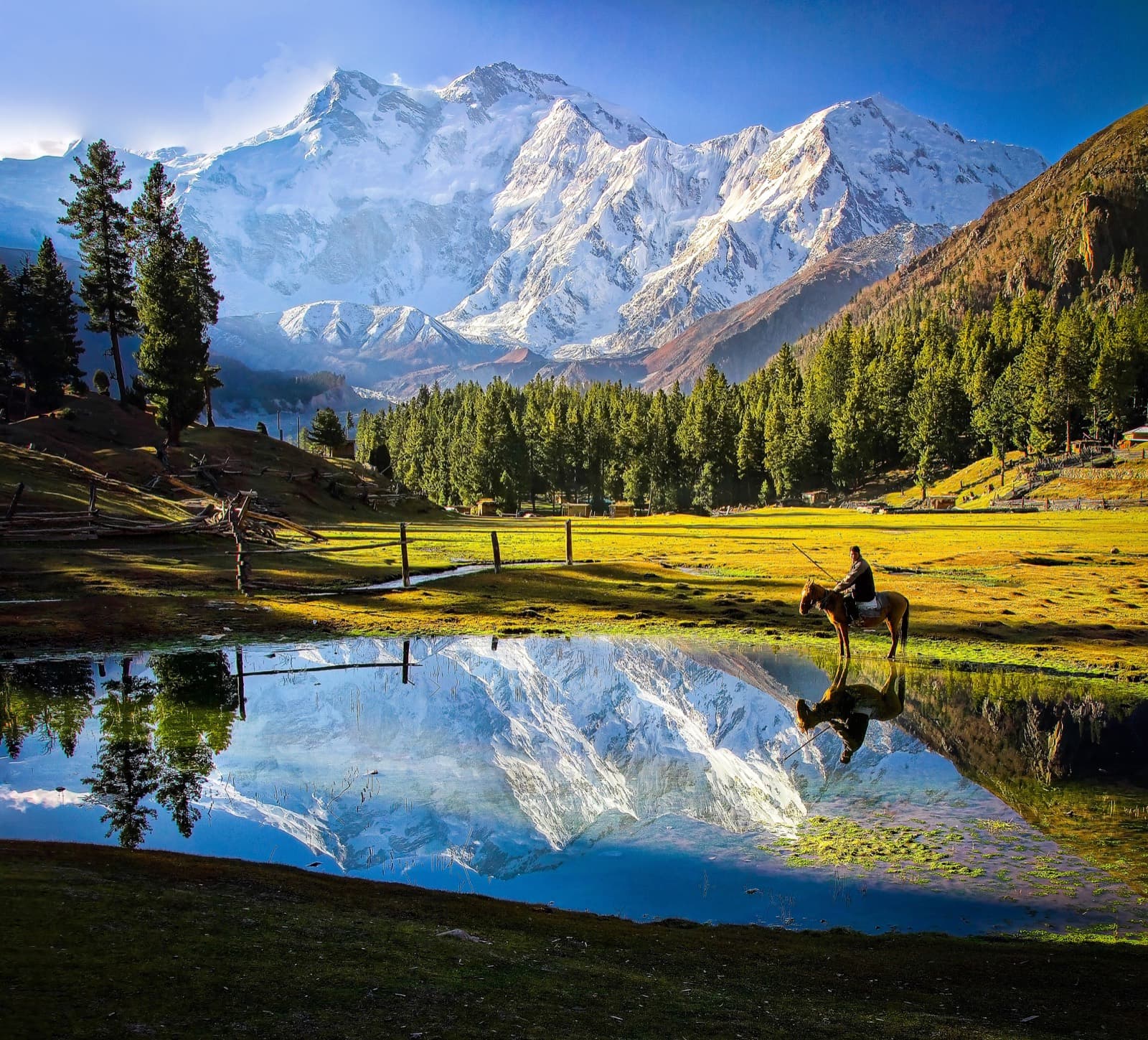 12N / 13D
Ultimate Pakistan Tour – 13 Days from Islamabad to Lahore via the Karakoram
Thirteen days from Islamabad to Lahore by way of Fairy Meadows, Nanga Parbat Base Camp, Hunza, the Khunjerab Pass and Skardu's cold desert.
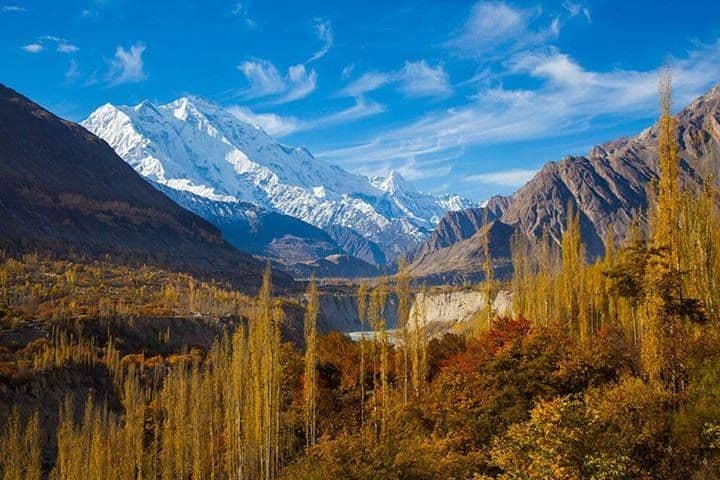 12N / 13D
Gilgit-Baltistan Autumn Tour (Hunza & Skardu)
Thirteen days chasing the golden season down the Karakoram Highway, from Skardu and Khaplu to Hunza and the Khunjerab Pass.